
The phone doesn't know you're closed. It rings at half seven, at Sunday lunchtime, the moment both your hands are inside a job that can't wait. Whoever answers gets the work. In a one-or-two-person business, mostly nobody does.
An AI receptionist is software that picks up when you can't — it answers the routine questions, books the job into the calendar and texts the caller a confirmation. We build websites and AI automations for Irish small businesses, and partway down this page you can hear two calls our own build handled for a Dublin garage. Judge it with your ears, not our adjectives.
Below: real market prices, the missed-call numbers that stand up to checking, one famous statistic that doesn't, and a straight answer on whether you need this at all.
The short version:- An AI receptionist holds an actual conversation — not a press-1 menu — and can check a live calendar and book the appointment before the caller hangs up.
- In the most detailed study available, only 37.8% of business calls were answered by a live person, and 80–90% of callers who reach voicemail hang up without leaving a message.
- Named products run roughly €42 to €432 a month (international tools price in US dollars; the euro figures here are approximate); our after-hours service is €199/month with no setup fee for early clients.
- Best fit: service businesses with routine, bookable enquiries — roughly 30–150 calls a month. Wrong fit: complaints, emergencies, anything needing expert judgement on the spot.
- It works by forwarding your existing number after closing time — no new number, nothing new to print on the van.
Prefer to listen or watch?
Same article, two other ways: a 24-minute audio deep-dive and an 8-minute video overview that walk through the costs, the demo calls and the honest "when it's not worth it".
What an AI receptionist actually does (and what it is not)
Strip the marketing off and it's this: cloud software that answers your incoming calls on its own. It turns the caller's speech into text, uses a language model to work out what they're after, takes an action — checks the calendar, answers the question, triggers a transfer to you — and speaks the reply back in a generated voice. The whole loop runs live, inside the call.
It is not a phone tree. A press-1 menu plays recordings and waits for keypresses; wander off the options and you start again from the top. The conversational kind handles free-form sentences and can cover several topics in one call without restarting.
The accuracy gap between the two is wide. Old menu-driven speech recognition works out what the caller wants 60–70% of the time; language-model systems reach 90–95%. Callers vote on this with their thumbs: phone-tree systems lose 35–45% of callers to abandonment, while conversational systems hold that under 12%. Among younger callers the patience is thinner still — 48% of millennial and Gen Z callers hang up rather than fight a complicated menu.
The part that earns its keep is booking. Mid-call, the system checks real availability, offers a slot and confirms it before the caller hangs up, then follows with an SMS or email confirmation. Nobody waits for a callback, so nobody drifts off to ring someone else while waiting.
It is also not a human, and pretending otherwise is where these projects go wrong. Complex troubleshooting, a heated complaint, a high-stakes sale — a properly built system knows it's out of its depth there and routes the call to a person. If a vendor tells you theirs never needs to, walk away.
Could you build one yourself? The parts exist — transcription, a language model, calendar access, SMS — and if you've ever wired a chatbot into a website, the shape will look familiar; we wrote up that side of things in our piece on AI chatbot integration. A phone call is the same machinery with no second chances, because the caller won't sit quietly while you debug it.
The missed-call problem nobody totals up
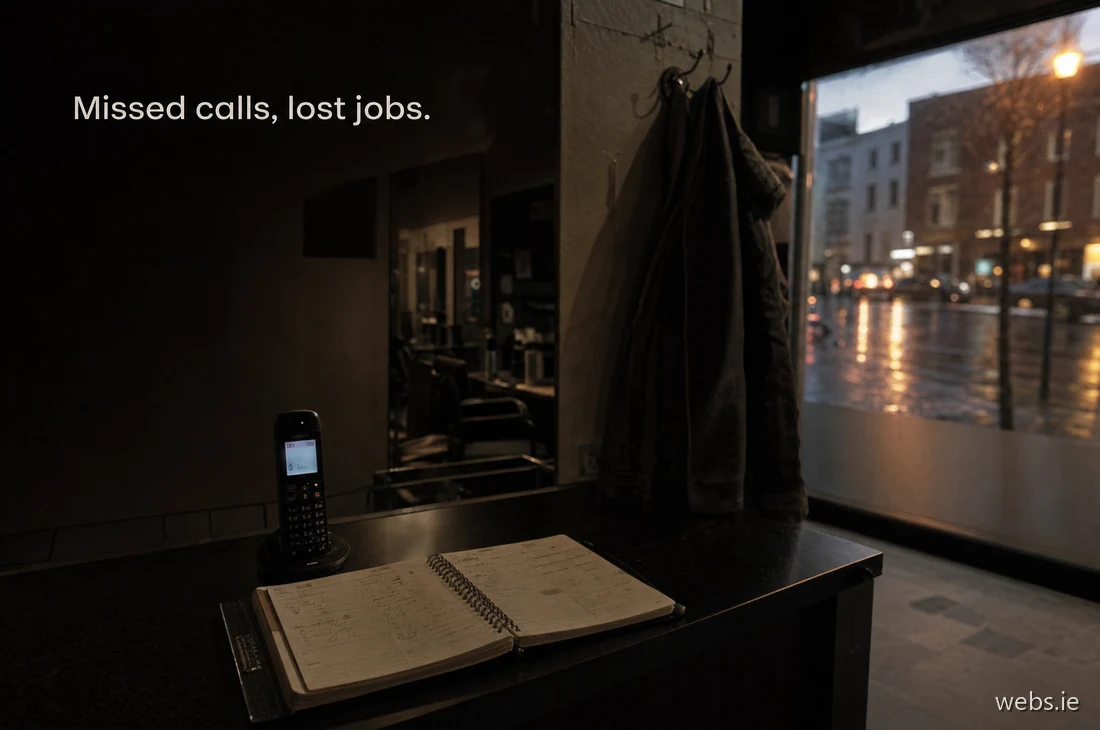
A missed call leaves no trace. No invoice, no line in the accounts, no complaint. The job simply happens somewhere else, and you never learn it existed.
The most granular study available comes from 411 Locals, which in 2024 analysed calls to 85 businesses across 58 industries. A live person answered 37.8% of the time. Another 37.8% of calls went to voicemail. The remaining 24.3% got nothing at all — no person, no machine, just ringing out.
Timing is most of the problem. Roughly one call in three arrives before opening, after closing or at the weekend, and the wider industry estimate puts 35–45% of service-business calls outside standard hours. That second figure is widely cited without a single named study behind it, so treat it as directional rather than gospel — but it agrees with what your own phone already tells you.
Voicemail doesn't catch the overflow. Hiya's State of the Call data, as cited in industry write-ups, puts voicemail abandonment at 80–90%: callers hear the beep and hang up.
The breakdown gets worse exactly where the money is. After hours, 89% of callers leave no message. First-time callers — the new customers — abandon at 85%. On urgent calls the rate is 93%, and even repeat customers hang up 72% of the time.
Where do they all go? 62% ring a competitor immediately — not later that evening, immediately, while the problem is still in their hand.
On cost, one US call-centre firm estimates the average small business loses about €109,000 a year to missed calls (their figure, converted from dollars). That's a vendor's number with unpublished workings, so take the direction, not the digits.
One more number deserves a flag, because you'll meet it on every sales page in this market: "78% of customers buy from the business that responds first." Nobody can trace it to a primary study — a review of every major lead-response study followed the citations and found the trail simply ends. What does hold up is older and sharper: the 2007 InsideSales.com/MIT Lead Response Management study looked at 15,000+ leads at six companies over 3 years and found the odds of qualifying a lead were 21 times higher when it was called within 5 minutes rather than after 30. Speed genuinely wins. The 78% just isn't the proof of it.
Listen: two calls our AI receptionist handled for a Dublin garage
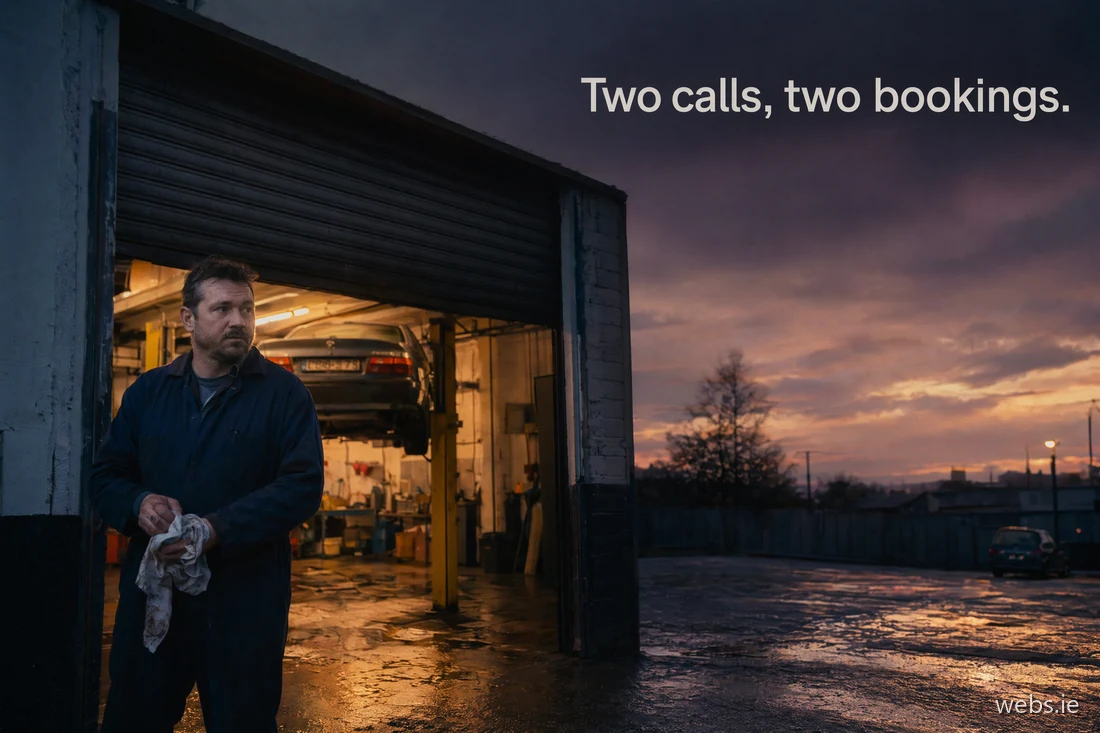
Numbers argue; audio settles it. In June 2026 we built an after-hours receptionist demo for Pro Auto Repairs, a garage on the Crumlin Road in Dublin 12, and we run it still. Both recordings below come from that build.
In the first call it's evening, the garage is shut, and the caller's car won't start the day before an NCT test — the agent triages what's wrong and books a morning slot.
In the second, a customer rings about an annual oil and filter service, and the receptionist proposes a free slot and books the appointment.
Full disclosure on what you just heard: these are scripted demo renders of the agent's real call flows, with synthesised voices — not recordings of actual customers. We'd rather flag that ourselves than have you spot it and wonder what else got polished.
Notice what's absent, though. No menu. No "your call is important to us". No promise of a callback. The caller states an actual problem and leaves with a booked slot and a text confirmation on the way.
How much does an AI receptionist cost?
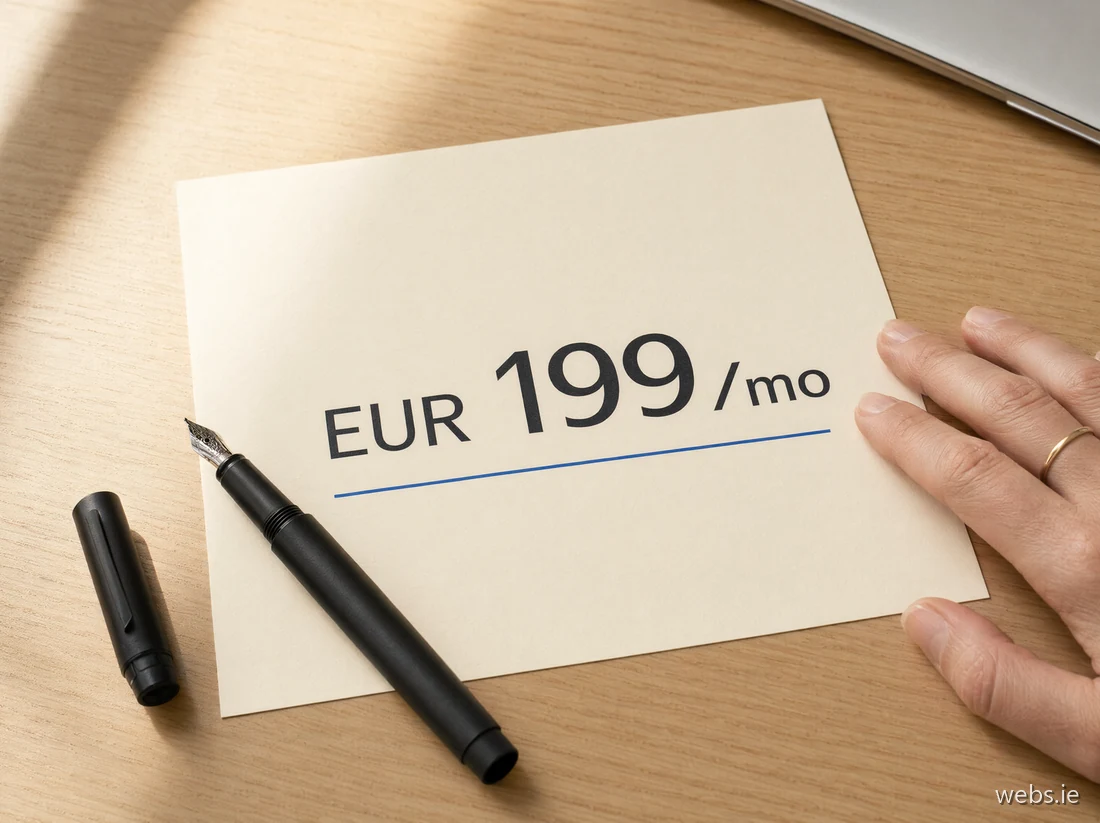
For the named products with public pricing pages — checked June 2026 — the realistic range is roughly €42 to €432 a month. They all price in US dollars, so the euro figures here are approximate, converted at the ECB reference rate for 12 June 2026 (€1 = $1.1567 = £0.86305).
| Service | Monthly price (≈ EUR) | What that buys |
|---|---|---|
| Rosie Professional | ≈ €42 | 250 minutes, message-taking, spam detection |
| Rosie Scale | ≈ €129 | 1,000 minutes, calendar booking, warm transfers |
| Rosie Growth | ≈ €258 | 2,000 minutes, unlimited scenarios |
| Smith.ai | ≈ €432 | 24/7 coverage; live-agent handoff ≈ €2.60/call |
| NextPhone | ≈ €172 flat | Unlimited calls, no setup fees, month-to-month |
Watch the footnotes when you compare. Smith.ai's monthly plan lists a roughly €1,730 one-time AI training fee on top of the €432, and minute caps matter more than they look — a busy line gets through 250 minutes quickly.
The human alternatives frame those prices. A traditional live answering service in the UK runs about €174–€637 a month depending on call volume, at per-minute rates of roughly €1.39–€2.90. Ruby, a human receptionist service, starts at about €216/month for 50 minutes and runs to roughly €1,491/month for 500 minutes, with overage near €4.49 a call.
And hiring? Morgan McKinley's 2026 salary guide puts a Dublin receptionist at €35,000–€40,000 base. Employer PRSI — 11.25% on earnings above €552 a week from January 2026 — adds roughly €3,900–€4,500, so you're carrying €39,000–€45,000 a year before pension, holiday cover or sick days.
A good receptionist does far more than answer a phone, to be fair. But if the specific hole in your week is the phone after six, a salary is an expensive patch for it.
The honest answer to "which one is best" is that it falls out of your call pattern. Messages only — the cheap end does fine. Bookings made mid-call — you're in the middle tiers. A guaranteed human catching the handover — the dear end. Anyone naming a single winner without asking about your calls is reading from a script.
Ours, since you'll be wondering: €199/month, no setup fee for early clients. After-hours answering on your existing number — routine questions handled, bookings taken, SMS confirmations sent.
If you want to set that against the table above, the breakdown is in our pricing section.
Is an AI receptionist worth it for your business?
Depends on the calls. The businesses that benefit are the ones whose calls repeat — bookings, availability, prices, opening hours. The industries that come up again and again in the research are home services like plumbing and electrical, dental and medical practices, auto repair, real estate and law firms.
On volume, published guidance puts the compelling zone at roughly 30–150 calls a month: enough traffic for missed calls to cost real money, routine enough that the machine resolves most of them unaided.
A widely shared r/smallbusiness thread draws the line differently — 30–40 calls a day as "the tricky middle zone", too many to answer yourself, too few to justify a front desk. That's forum sentiment rather than a study, but it names the squeeze well: the receptionist question gets urgent long before a receptionist salary makes sense.
Now the caveat most vendors skip. A Gartner survey of 5,728 customers found 64% would prefer companies not use AI for customer service at all. That's most of your callers. The same guide that cites the survey notes the preference flips when the AI is upfront about being software and hands difficult calls to a human cleanly. People resent being fooled far more than they resent talking to a machine.
Where the effect has been measured properly, it's large. Dental practices are the best-studied case: phone-tree systems convert 15–25% of inbound calls into appointments, conversational agents 45–60% — roughly three times as many. No-shows drop as well, from 18–25% to 8–12%, mostly down to automated confirmation messages. Dental numbers, mind. Treat them as the ceiling, not the promise.
And when should you keep your money? When the phone barely rings — a handful of calls a week doesn't justify €199 a month, however clever the software. When your calls are mostly complaints, because an upset customer needs a human ear, not a fluent script. And when callers need expert judgement on the spot, because the machine's only correct move there is handing over anyway.
| Points toward yes | Points toward no |
|---|---|
| Routine, bookable enquiries: slots, prices, opening hours | Complaints and emotionally loaded calls |
| Calls landing after hours and dying in voicemail | Enquiries needing live expert troubleshooting |
| Roughly 30–150 calls a month | A handful of calls a week |
| Jobs you know you've lost to an unanswered phone | High-stakes sales negotiations |
How to get started (without changing your number)
Deployment is the undramatic part. Your number stays your number: at closing time, call forwarding sends the line to the receptionist, and in the morning it falls back to you. No new number — nothing new to print on the van, the cards or the shopfront.
What we need from you is the knowledge you already carry around: what you do, what you charge, what counts as urgent, when the diary has room. The receptionist can only answer with what it's been given, so the setup is really a transfer of your front-desk instincts into the system.
If this still sounds exotic for an Irish small business, the statistics disagree — gently. CSO figures for 2025 show AI use among Irish enterprises rising from 8.1% in 2023 to 20.2% in 2025; among small firms of 10–49 employees it stands at 17.2%. No longer unusual, then — but still early enough that most of your competitors haven't moved.
And if the phone side is sorted but the website is the weak link, there's support for that too — see the website grant for Irish small businesses.
If you'd like the phone answered tonight after you lock up, get in touch. Tell us what your callers usually ask for, and we'll tell you straight whether an AI receptionist would earn its keep — and if it wouldn't, we'll say so.
