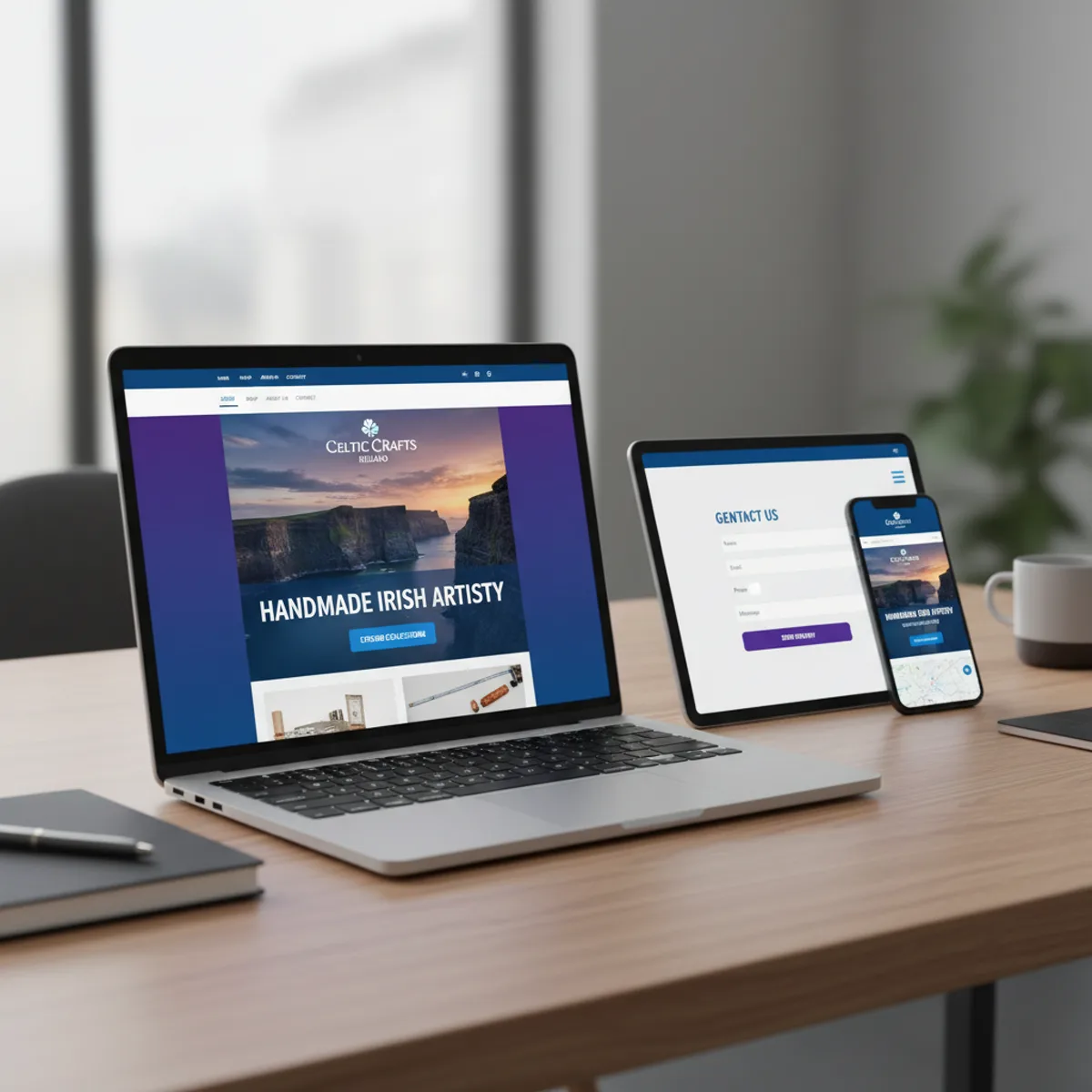
Why Does My Small Business Need a Website in 2025?
Your small business needs a website in 2025 because most consumers now research businesses online before making a purchase decision, and website design quality shapes how credible your company looks at first glance.
Without a website, you're invisible to the many potential customers who search "near me" on their phones, a search type that has grown sharply over the past several years.
Quick Answer: A website serves as your 24/7 digital storefront, establishing credibility, expanding customer reach, reducing marketing costs, and competing effectively against larger competitors, often paying for itself within the first year.1. Build Trust and Professional Credibility Instantly
What Makes a Business Website Credible?
Modern consumers expect every legitimate business to have a professional website. Most consumers read online reviews before visiting a local business, and displaying verified reviews on your website tends to improve conversion rates.
Essential credibility elements for 2025:- ✅ Custom domain name (yourbusiness.ie instead of free hosting)
- ✅ SSL certificate (HTTPS padlock showing security)
- ✅ Clear contact information (phone, email, physical address)
- ✅ Real customer testimonials with names and photos
- ✅ Professional photography and consistent branding
- ✅ About Us page with your business story
- ✅ Privacy policy demonstrating legal compliance
- ✅ Trust badges (certifications, awards, memberships)
How Do Irish Customers Judge Website Credibility?
Irish consumers specifically look for:
- Local phone numbers (Dublin 01, Cork 021, Galway 091 prefixes)
- Irish address with Eircode for verification
- Euro currency and Irish payment methods
- References to Irish regulations (GDPR compliance, Revenue registration)
- Local testimonials from other Irish businesses
Cost vs Value Analysis
Website Investment: €800-€2,500 (one-time) + €150-€400/year hosting Traditional Credibility Building: €10,000+ (print ads, brochures, events) ROI Timeline: Most Irish SMEs recover website investment within 3-4 months through increased enquiries.2. Capture Sales 24/7 Without Geographic Limits
How Does a Website Work When You're Closed?
Your website is an always-on sales representative, answering questions, displaying products, accepting bookings, and processing orders while you sleep. This matters because:
- A meaningful share of online shopping happens in the evening, outside business hours
- Mobile devices account for a large share of e-commerce sales
- After-hours website visitors generate leads you'd otherwise miss
What is Local SEO and Why Does It Matter?
Local SEO (Search Engine Optimization) helps your business appear when nearby customers search "near me" or "[service] in [city]". What this means in practice:
- People who search on their phone for something nearby often visit that business within a day
- A meaningful share of local searches lead to a purchase soon after
- "Near me" searches have grown sharply over the past five years
- Claim your Google Business Profile
- Include your Eircode on every page
- Create location-specific content
- Build local citations (directories, listings)
- Collect and display Google reviews
Can a Website Expand My Service Area?
Yes! Even traditional local businesses use websites to:
- Serve wider geographic areas (county-wide instead of town-only)
- Offer online consultations (Zoom/video calls)
- Sell products nationally (with delivery/shipping)
- Build brand awareness beyond immediate locality
3. Reduce Marketing Costs with a Digital Presence
How Much Does Traditional Marketing Cost in Ireland?
Annual Marketing Costs Comparison (Ireland 2025):| Marketing Channel | Annual Cost | Reach | Trackability |
|---|---|---|---|
| Local newspaper ads | €3,600-€12,000 | Limited | None |
| Radio advertising | €5,000-€25,000 | Regional | Low |
| Outdoor billboards | €3,500-€18,000 | Geographic | None |
| Print flyers/leaflets | €2,000-€8,000 | Local | None |
| Professional website | €800-€2,500 (once) | Global | 100% trackable |
What ROI Can I Expect from a Business Website?
What Irish SMEs typically see:- Website investment tends to pay for itself within the first year
- The strongest-performing websites see especially strong returns
- Payback period: 3-6 months typical
- Returns tend to compound in year two and beyond as SEO and content build up
How Does Content Marketing Generate Leads?
Every blog post, FAQ, or guide you publish becomes a permanent lead generation asset:
- Ranks in Google for months/years
- Answers customer questions automatically
- Builds industry expertise and authority
- Generates organic traffic without ad spend
- Can be shared across social media
4. Compete Effectively Against National Chains
How Can Small Businesses Compete with Large Companies Online?
Small businesses have unique advantages in digital competition:
Small Business Strengths:- ✅ Local expertise - Deep community knowledge
- ✅ Personal service - Owner involvement and flexibility
- ✅ Niche specialization - Focused expertise vs broad offerings
- ✅ Authentic storytelling - Real stories, not corporate messaging
- ✅ Faster adaptation - Quick updates and pivots
- ✅ Customer relationships - Personal connections at scale
What Search Terms Should Small Businesses Target?
High-Value Local Keywords (Examples):❌ Avoid: "web design" (too competitive, broad)
✅ Target: "web design for Irish accountants Dublin" (specific, less competitive)
❌ Avoid: "plumber" (generic, dominated by directories)
✅ Target: "emergency plumber Sandyford 24 hour" (intent + location)
❌ Avoid: "solicitor" (broad, national firms dominate)
✅ Target: "family law solicitor Drogheda free consultation" (specific service + location + offer)
Long-Tail Keyword Strategy: Target 10-15 specific phrases rather than 1-2 broad terms. Less competition, higher conversion rates, faster rankings.5. Control Your Brand Message and Online Reputation
Why Do Businesses Need to Control Their Online Presence?
Without a website, you're letting others define your brand:
Risks of No Website:- ❌ Google reviews appear without context
- ❌ Facebook page algorithm limits your reach
- ❌ Competitors' sites rank for your business name
- ❌ Outdated directory information misleads customers
- ❌ No central hub for accurate information
- ✅ Tell your complete story (not 160-character bios)
- ✅ Showcase full service range with detail
- ✅ Address common concerns proactively
- ✅ Display comprehensive portfolio/case studies
- ✅ Own the conversation around your brand
How Do I Respond to Negative Reviews Professionally?
Your website provides a platform for proactive reputation management:
- FAQ section addressing common concerns before they become reviews
- Testimonials page balancing occasional negative feedback
- Blog posts demonstrating expertise and problem-solving
- Case studies showing real results for real customers
- About Us humanizing your business and building connection
- Acknowledge the feedback publicly
- Offer to resolve privately (email/phone)
- Link to website resources (policies, FAQs)
- Demonstrate commitment to improvement
- Follow up and update when resolved
6. Integrate Modern Business Tools and Automation
What Automation Tools Can Websites Provide?
Business-Boosting Website Integrations (2025): For Service Businesses:- 📅 Online booking systems (Calendly, Acuity, custom)
- 💬 AI chatbots (24/7 customer support)
- 📧 Email automation (welcome series, follow-ups)
- 💳 Online payments (Stripe, PayPal, Apple Pay)
- 📊 CRM integration (HubSpot, Salesforce)
- 🛒 Shopping carts (Shopify, WooCommerce)
- 📦 Inventory management (real-time stock levels)
- 🚚 Shipping integration (An Post, DPD, Fastway)
- 🔔 Abandoned cart recovery (automated emails)
- 🎁 Loyalty programs (points, rewards, discounts)
How Much Time Does Automation Save?
Time Savings Analysis:- Manual booking → Online booking: frees up meaningful time each week
- Phone enquiries → AI chatbot: cuts down on time spent answering routine questions
- Email follow-ups → Automation: saves time on repetitive follow-up
- Payment processing → Online payments: speeds up reconciliation
- Appointment reminders → Automated SMS: cuts down on no-shows and manual reminders
7. Gather Data and Make Informed Business Decisions
What Analytics Do Business Websites Provide?
Modern websites provide actionable insights impossible with traditional marketing:
Key Metrics You Can Track:📊 Traffic Analytics:
- Visitor numbers (daily, weekly, monthly)
- Traffic sources (Google, Facebook, direct, referrals)
- Geographic location (city, county, country)
- Device types (mobile, desktop, tablet)
🎯 Behavior Analytics:
- Most viewed pages/products
- Time spent on site (engagement)
- Bounce rate (quick exits)
- User journey paths (navigation patterns)
💰 Conversion Analytics:
- Lead generation (forms, calls, emails)
- Sales/revenue attribution by source
- Cost per acquisition (CPA)
- Return on ad spend (ROAS)
- Customer lifetime value (CLV)
How Do I Use Website Data to Grow My Business?
Actionable Insights Examples: Insight: "Most of my traffic comes from mobile" Action: Prioritize mobile-first design and speed optimization Insight: "The services page holds attention longer than other pages" Action: Add video demonstrations and detailed FAQs Insight: "Visitors leave the pricing page almost immediately" Action: Simplify pricing, add value explanations, include testimonials Insight: "Blog posts about [specific topic] consistently generate more leads than others" Action: Create more content on high-performing topics Insight: "Saturday mornings see a traffic spike but no staff for phone calls" Action: Add online booking or AI chatbot for weekend coverageWhat's the Difference Between Guessing and Knowing?
Traditional Marketing (Guessing):- "I think the flyer worked..." (no proof)
- "Maybe the radio ad brought customers?" (can't verify)
- "I hope people see the billboard..." (no metrics)
- "Google Ads generated 47 leads at €12 each, converting at 23%" (exact data)
- "Blog post X attracted 234 visitors and 8 paid consultations" (full funnel tracking)
- "Email campaign had 34% open rate, 12% click rate, 5 bookings" (precise attribution)
Frequently Asked Questions (FAQ)
How much does a business website cost in Ireland?
Website costs in Ireland range from €800-€2,500 for small business sites, plus €150-€400 annually for hosting and maintenance. Complex e-commerce sites can cost €3,000-€10,000+. Most businesses recover this investment within 3-6 months through increased enquiries and sales.
Can I build my own business website for free?
Yes, platforms like Wix, Squarespace, and WordPress.com offer free tiers, but they come with limitations: branded URLs (yourbusiness.wix.com), limited functionality, poor SEO, and no professional credibility. For business use, invest €800-€1,500 in a proper website with custom domain and professional design.
How long does it take to build a business website?
Professional business websites typically take 2-6 weeks from brief to launch, depending on complexity. Simple 5-page sites can be completed in 2-3 weeks. E-commerce sites with custom features may take 6-12 weeks. DIY websites can be launched in days but require months to optimize properly.
Do I need a website if I have Facebook and Instagram?
Yes. Social media platforms should complement, not replace, your website. Reasons: (1) You don't own social platforms, they can change rules or shut down access to your audience, (2) Only a small fraction of followers see your posts organically, (3) Social profiles don't rank well in Google searches, (4) Professional credibility requires a proper website domain.
What's more important: website or social media in 2025?
Your website is your foundation; social media is your megaphone. Irish consumers expect businesses to have both, and tend to judge credibility by the website first. Social media drives traffic to your website, but your website converts visitors to customers. Prioritize website first, then build social presence.
How do I get my website to show up on Google?
Google visibility requires: (1) Basic SEO (titles, headings, descriptions), (2) Google Business Profile setup, (3) Mobile-friendly design, (4) Fast loading speed, (5) Quality content (blog posts), (6) Local citations (directories), (7) Customer reviews. Most businesses see Google rankings within 3-6 months with consistent effort.
Do small businesses really need e-commerce websites?
Not all small businesses need e-commerce, but those selling products or bookable services should consider it. E-commerce benefits: 24/7 sales, lower staff costs, expanded geographic reach, automated inventory, customer convenience. Even service businesses benefit from online booking and payment systems.
What's the ROI timeline for a business website?
Most Irish SMEs see positive ROI within 3-6 months. Timeline factors: industry competition, marketing effort, SEO optimization, website quality. Typical pattern: Months 1-3 (setup and initial traffic), Months 4-6 (growing rankings and leads), Months 7-12 (compounding returns).
Can I update my own business website or do I need a developer?
Modern content management systems (WordPress, Shopify, Webflow) allow non-technical owners to update text, images, and blog posts. For structural changes (new pages, features, design), most businesses hire developers. Best approach: Launch professionally, then handle routine content updates yourself.
What happens if I don't have a business website in 2025?
Without a website, you're invisible to most consumers who research online before buying. Consequences: (1) Competitors capture your potential customers, (2) Real lost revenue over time as competitors with a stronger online presence win the business instead, (3) Perceived as less credible or outdated, (4) No data on customer behavior, (5) Higher marketing costs with lower returns.
Take Action Today: Your Website Implementation Checklist
Immediate Steps (Week 1):
✅ Secure your domain name (.ie for Irish businesses)
✅ Choose hosting provider (Irish-based recommended)
✅ List your key services (top 3-5 offerings)
✅ Gather testimonials (ask 5-10 satisfied customers)
✅ Collect business photos (team, location, work examples)
Build Phase (Weeks 2-4):
✅ Create 5 core pages (Home, About, Services, Testimonials, Contact)
✅ Write clear service descriptions (benefits-focused, not feature lists)
✅ Add contact information (phone, email, address, Eircode, map)
✅ Set up Google Business Profile (link to website)
✅ Install analytics (Google Analytics 4)
Launch & Optimize (Weeks 5-8):
✅ Launch website (announce on social media, email list)
✅ Submit to Google (Google Search Console)
✅ Create 2-4 blog posts (answer common customer questions)
✅ Monitor performance (traffic, enquiries, conversions)
✅ Gather feedback (ask customers and team)
Ongoing (Monthly):
✅ Publish 2-4 blog posts (SEO-focused content)
✅ Update service offerings (seasonal, new services)
✅ Add new testimonials (recent customer feedback)
✅ Review analytics (what's working, what's not)
✅ Test and optimize (improve high-traffic pages)
Your Website is Your Business Foundation
In 2025, a professional business website is the foundation of modern business success. As more consumers search online before buying, your website increasingly determines whether you capture or lose potential customers to competitors.
Your Next Step: Don't let another month pass losing customers to competitors with a stronger online presence. Contact Webs.ie today for a free website consultation and discover how we can build an AI-powered website that generates leads while you sleep. Get Started: Book Free Consultation | See Our Work | Get Instant QuoteAbout Webs.ie: Ireland's leading AI-powered web design agency based in Dublin. We specialize in building smart websites for Irish small businesses that generate leads, increase sales, and deliver measurable ROI. Since 2020, we've helped 200+ Irish businesses establish powerful online presence with modern, mobile-first websites optimized for 2025 search engines and AI assistants. Contact: Dublin, Ireland | [email protected] | +353 1 XXX XXXX Related Articles:
